Hot water on demand
A tankless unit heats water as you use it. Capacity still matters: several fixtures can exceed the output available at your incoming water temperature.
Right-sized hot water for the way your home works. Plan your tankless installation, replacement or repair with the connections and demand thought through.
A compact unit still needs working space, service access and an equipment-specific connection plan.
Conceptual illustration · not an installation diagram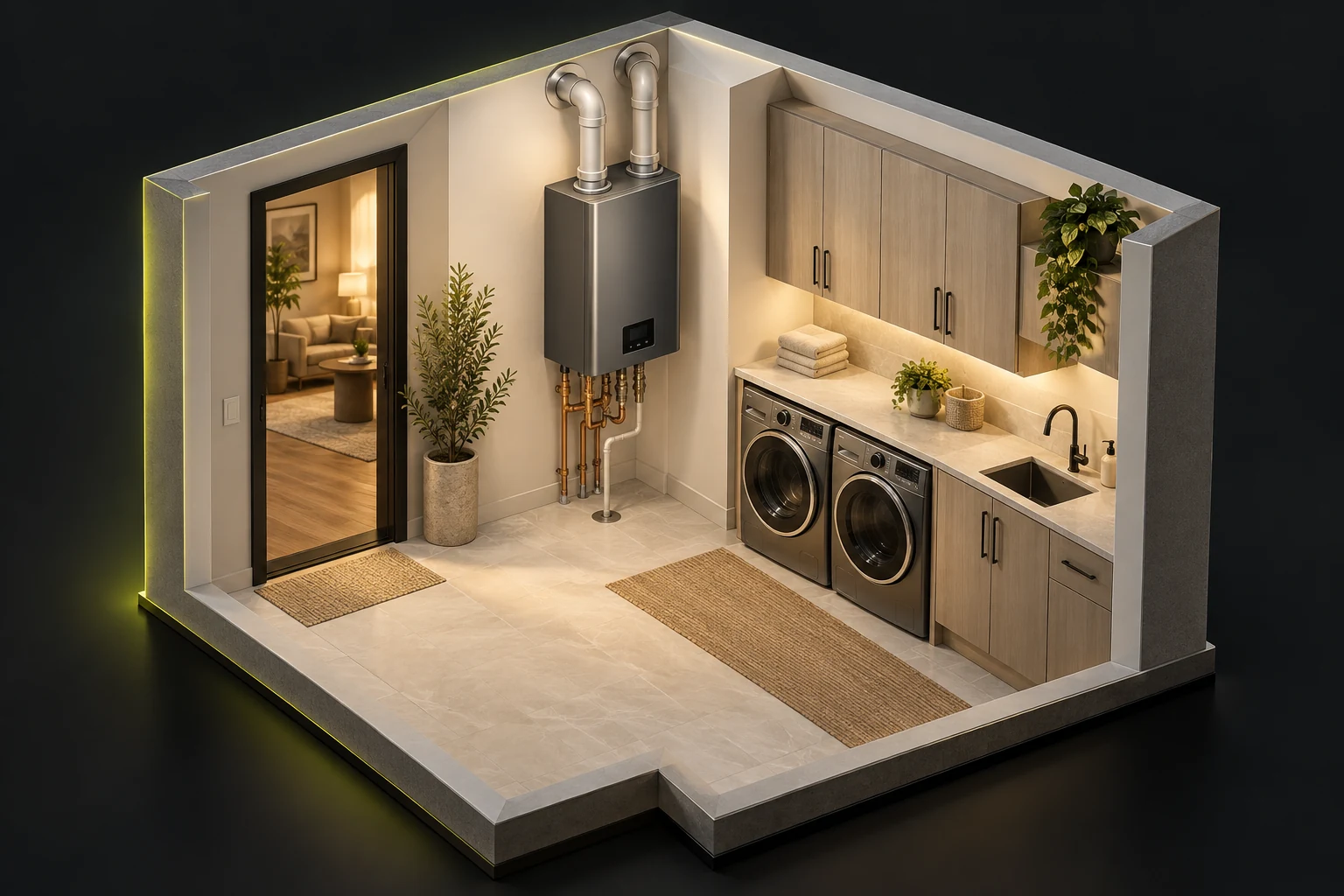 HAUSE / MECHANICAL ROOM STUDY
Tankless can free space and heat water on demand. The right fit depends on simultaneous use, incoming water temperature and your home’s connections. A complete assessment comes before the equipment choice.
Six practical benefits, with the details that make each one useful.
A tankless unit heats water as you use it. Capacity still matters: several fixtures can exceed the output available at your incoming water temperature.
Wall mounting can free floor space. The actual layout must leave the manufacturer’s service clearances, approved vent route and access to connections.
You are not keeping a large tank hot between uses. Actual running costs depend on equipment, fuel prices, usage and any recirculation schedule.
Model choice, parts availability, water quality and maintenance all matter. Compare warranty terms and service access rather than relying on a promised lifespan.
There is no large reservoir in the appliance. Plumbing connections can still leak, so drainage, access and leak protection deserve attention.
A compatible return loop or approved retrofit can reduce waiting at distant taps. Ask about controls, pipe layout and the energy cost of keeping the loop warm.
Describe the outcome you need. The provider confirms the qualified trades, permit holders and actual scope.
A conversion changes the whole hot-water system. Start with peak fixture demand, the incoming water temperature and the home’s existing services.
A new model needs its own review. Reusing the old connections or vent is only appropriate when the new manufacturer’s requirements and site conditions support it.
An error code describes a condition to investigate; it does not establish the repair. Record the model, symptoms and what was running when the issue appeared.
Gas equipment has electrical requirements too. Whole-home electric tankless equipment can add substantial demand that needs an electrician’s assessment.
Two showers at once. Laundry after hockey. A tap at the far end of the house. Tell us how hot water fits into your day.
Peak simultaneous use and temperature rise shape available output. Household size adds context; it does not determine a heater’s capacity.
One appliance. A complete connection plan.
Conceptual illustration · not an installation diagram or completed projectAsk for available output at the required temperature rise, rather than relying on the advertised maximum flow.
Fuel capacity, other appliances and electrical requirements belong in the assessment with water demand.
The route to taps, recirculation design and controls affect waiting time and everyday performance.
Eight parts of the project to keep together before installation is scheduled.
Ask a qualified gas fitter to assess the proposed appliance input alongside the other gas appliances. A larger unit can change supply requirements.
Confirm approved vent material, route, length, clearances and termination for the exact model. An existing tank flue is not an automatic match.
Check the manufacturer’s supply and protection requirements. Electric tankless equipment needs a load and circuit review; a 200A label alone proves neither suitability nor capacity.
Condensing equipment needs an approved drainage arrangement. Confirm whether treatment, a pump or a different route belongs in the quote.
Map the distance to frequently used taps and any return line. Compare a compatible controlled loop with the cost and complexity of adding one.
Confirm the exact work with the permit authority. Calgary distinguishes plumbing, gas and electrical work; a blanket building-permit rule is not a substitute for the project scope.
Clarify who drains and removes the old appliance, disposes of it and restores affected walls or finishes. Existing-material concerns require their own qualified review.
Request the model details, completed testing, operating guidance, maintenance schedule, warranty information and applicable permit/inspection records.
Know who confirms the scope, approvals, timing and handover at each stage.
Share the current heater, community, household demand and preferred timing. The planner’s answers are included with your request.
The team reviews the request and confirms availability, the appropriate trade and what information or site visit is needed.
Ask for the equipment, connections, permits, disposal and restoration boundaries together. An online request is not a final quote.
Confirm the permit holder, inspection requirements and any supply work before an installation date is agreed.
The qualified installer follows the equipment requirements and agreed scope. Access and complexity determine the schedule.
Retain commissioning information, warranty terms, operating instructions, maintenance guidance and inspection records where applicable.
Compare the complete installation. Site conditions make an online fixed price a poor substitute for a written scope.
Compare the proposed model, output at the design temperature rise, features and warranty. A headline maximum flow rate is only one part of the decision.
The route, termination and compatibility with the proposed appliance can change labour, materials and restoration.
Meter capacity, pipe sizing and other appliance loads may create a separate supply scope. Confirm the boundary with the gas fitter and utility where needed.
New circuits or supply changes should be itemized separately. Gas and electric tankless systems have different electrical demands.
Condensate routing, pumps, treatment and a return loop can change installation and future operating costs.
List applicable applications, inspections, site access, old-unit removal and finish repairs so competing proposals cover the same work.
Unit age, symptoms and an error code are starting information. The decision should follow the findings, repair scope and the complete replacement proposal.
One appliance. A complete connection plan.
Conceptual illustration · not an installation diagram or completed projectBrand-neutral planning. Mentioning a brand does not claim manufacturer authorization, current stock or service availability. The team confirms equipment support for the request.
Send your community with the request. The team confirms availability and the relevant permit authority for the property.
NW, NE, SW and SE requests start with the same useful records: current heater, peak use, proposed location and project timing. Calgary’s trade-permit guidance applies to work within the City.
Calgary installation guide ↗Share the municipality and any acreage or county context. A town address and a nearby rural address may have different permit and supply contacts. The provider should confirm the exact address.
For a conversion, include the current fuel type, other gas appliances and available mechanical-room space. Confirm who handles each connection and applicable local approvals before scheduling.
Distinguish the municipality from the surrounding county in your request. Include any suite or renovation plans that could change demand and the proposed work.
For a rural property, note natural gas or propane, the water source and known water-treatment equipment. These details help the provider identify the assessment needed.
Provide access information, fuel availability and service history where known. Do not assume a Calgary permit applies outside City limits; confirm the authority and provider availability.
Also named in this resource: Strathmore, Crossfield, Carstairs, Didsbury and Olds. Project requests are welcome; travel scope and availability are confirmed individually.
Clear answers for the next conversation with your qualified provider.
Editorial references reviewed September 30, 2026. Requirements and equipment suitability depend on the address, model and actual work.
It depends on the actual work. Calgary lists water heaters among gas-permit work and describes circumstances where plumbing changes need a permit. Have the contractor confirm gas, plumbing and electrical scope with the City before work starts. Do not assume every replacement needs a building permit.
Only if it is approved for the exact new appliance and installation. Vent material, route, length and termination need a qualified review against the manufacturer’s requirements.
Possible causes include demand beyond available output, supply issues, mixing or controls. Record which fixtures were on and the model details. A qualified assessment should establish the cause before recommending replacement.
The full model, displayed code, when it occurred, hot-water symptoms and recent servicing are useful. Do not open the unit or repeatedly reset it to work around a recurring fault.
Yes. Maintenance depends on the model, water quality and usage. Ask the servicer to follow the manufacturer’s schedule and assess scale, filters and other applicable items.
Use an appropriately qualified trade and confirm the permit requirements with the authority responsible for your address. Gas, venting and electrical work require their own competence and scope. This site does not provide installation instructions.
Compare the complete site fit: approved venting, condensate drainage, performance, service access and installed cost. A condensing model’s drainage requirements need to be planned alongside the appliance.
Many gas models require electricity for controls and operation. Confirm the exact manufacturer’s requirements and any approved backup arrangement; do not assume gas means independent of power.
Yes. Go directly to the quote form and select “not sure” where needed. If you use the planner, its assumptions and answers carry into the same request automatically.
No. It organizes simultaneous use and an illustrative temperature rise for professional review. The team must confirm site conditions, equipment performance and project scope before quoting.
Go deeper on Calgary installation, conversion, demand, repair and maintenance.
Plan the appliance, connections and approval scope together. A useful Calgary quote starts with your home’s actual demand.
Read the guide ↗The useful question is how the whole system fits your home. Compare supply, venting, drainage and demand before committing.
Read the guide ↗Start with simultaneous fixtures and temperature rise. Household size is useful context, but it is not a capacity calculation.
Read the guide ↗Keep the symptoms, model and service history together. Make the repair-versus-replacement decision from findings.
Read the guide ↗Protect performance with a schedule matched to the model, usage and water quality. Keep the service records with the equipment.
Read the guide ↗Request an installation, replacement, repair or maintenance quote directly here. Tell us what you know; “not sure” is a useful answer too.
The HAUSE team reviews your request and confirms the appropriate assessment, provider availability and scope. You do not need to open an email app or copy a brief.
Planner not completed. Direct quote request.
For a suspected gas leak, carbon-monoxide concern or immediate danger, leave the area and seek emergency help from safety. Do not wait for a website response.